Fire to the Prisons
In this first installment of Fire to the Prisons, a regular column in Heatwave Magazine dedicated to prisoner support, we turn to a small group of comrades who run the Uprising Support website, offering material and spiritual support for prisoners of the recent George Floyd Rebellion. In subsequent issues, we will highlight different prisoner support efforts and individual prisoners who are in need of support.
From the Editors:
The wave of uprisings that began in Ferguson, Missouri in 2014 and culminated in the George Floyd Rebellion of 2020 resulted in an undertow of new prisoners and detainees subject to the brutality of the carceral state. As the country with the highest incarceration rate on the planet, the United States has a storied history of repressing social rebellion. From colonial night watch systems and organized slave patrols to criminal syndicalism laws targeting partisans of the old workers’ movement to the more recent series of raids, grand juries, and prison terms colloquially known as the “Green Scare,” counterinsurgency is a plain weave in the fabric of everyday life. Today, many militants, like Mumia Abu Jamal and Sundiata Acoli, have been behind bars for a half-century. These rebels are living casualties of the war against the New Left, the Black and Red Power movements, and the Black Liberation Army. Others, like the ATL 61, have yet to face trial or sentencing, but nevertheless face the full weight of the state. New techniques and technologies have emerged, but the basic logic is invariant. Repression is a consistent feature of life under capitalism—stepping in where and whenever the mute compulsion of the market is insufficient to maintain order.
Historical and contemporary movements from below share an inveterate tradition of supporting political prisoners and campaigning for the abolition of the carceral state, long used as a cudgel to suppress rebellious factions of the working class and maintain the color line. The vigorous defense campaign run on behalf of the Haymarket Martyrs in the post-Reconstruction era ignited the classical workers’ movement and inaugurated the struggle for the 8-hour day. The support campaign for Sacco and Vanzetti, two Italian-American anarchists accused of a murder and subsequently executed for it, was a galvanizing moment for the nascent workers’ movement at the turn of the 20th century. During the same period, in response to state and federal repression, the IWW developed an extensive prisoner support culture that defined its legacy. The early CPUSA defended both politically charged cases, like the judicial lynching of the Scottsborough Boys, and communist POWs during the second Red Scare. And in the aftermath of repression against the American Indian Movement, the defense campaign for imprisoned militant Leonard Peltier was widely supported by civil society.
In keeping with this tradition, we want to dedicate space in each issue to highlight prisoner struggles and support efforts. To that end, we introduce “Fire To The Prisons,” a regular column dedicated to prisoner support. The name “Fire To The Prisons” is a nod to the popular anarchist magazine by the same name in circulation since 2007. While our project centers some struggles over others, we make no distinction between political prisoners and regular prisoners. For us, all prisoners are class war prisoners.1 In this first installment, we turn to a small group of comrades who run the Uprising Support website, offering material and spiritual support for prisoners of the recent George Floyd Rebellion. In subsequent issues, we will highlight different prisoner support efforts and individual prisoners who are in need of support.
***
Uprising Support:
At the time of this writing, the UprisingSupport.org website has the names of 14 people currently serving sentences for their alleged or expressed involvement in what came to be known as the George Floyd Uprising of 2020. When we started this site in the summer of 2021, that number was much higher, as many of the people we were tracking through various court and prison systems were still awaiting trial or sentencing. For those wrapped up in the ever-widening reach of the federal judicial system, trial was unlikely—the vast majority of federal cases are resolved through plea bargain. The prosecutors are too well funded and the penalties too stiff for many people to feel comfortable chancing what is colloquially known as the “trial tax”— the likelihood of doing more years by taking a charge to trial and losing instead of pleading out.
We started the website as a clearinghouse of information about how to support people awaiting trial or currently serving prison sentences from the 2020 Uprising. We found that the many of these people lacked formalized political support structures. Parents, partners, communities, and crews were trying to scrape together small amounts of money, support, and attention. Charges ranged from alleged mass looting actions, arsons, and curfew violations to things like posting on Facebook. In the COVID-19 chaos of backlogged state courts and shuttered grand juries, the scope of repression was scattered. While many of the communities affected routinely face criminalization, this wave of repression targeted acts with political intent. Many people who had been in the streets were being swept up in post-demonstration raids, arrested and charged without attention from the broader left and its organized political bodies. Our intent was to help bridge some of the gaps and provide as much information that consenting defendants could give us in the hopes that everyone facing state repression would have access to the kind of support, organizing, and care that has become synonymous with radical left anti-repression and anti-prison organizing in the United States.
Currently, federal prisoners are featured prominently on the site because they are the ones serving the longest sentences, often for now ubiquitous charges like civil disorder and various forms of arson. When the site began, and for the next few years, there was a higher percentage of people awaiting sentencing, trial, or doing their time at the state level. By our tally, there were somewhere between 350-400 cases charged at the federal level, but at the state and municipal level arrests numbered in the tens of thousands. With even only a fraction of those arrests leading to a criminal charge, conviction, and jail sentence, the number of criminalized people from a spectrum of communities was staggering.
Thankfully, in the past year we have been able to move many of those we reached out to in earlier stages of their criminal cases to our ‘Post-Release Support Page’ on the website. We hope that people will continue to offer solidarity to them as they transition back to the outside. Many of the people who have or will be released are going to struggle with housing, jobs, and getting connected to larger movements for racial justice and against the police. A common question we get is people wondering what someone needs after they are released. Besides the semi-obvious answer of material support (money, housing, employment), they need vibrant movements of resistance to re/turn to—spaces that can both soften the trauma of the blunt force of the carceral state and sharpen the edges of critical responses to police violence. There are many reasons to do prisoner support, but our overarching ethic remains that support for those locked up in the midst of a demo, an uprising, a movement for a world free from domination, coercion, and control means that those movements will last longer, be stronger, and more worth fighting for.
The small number of names on the website, even if you added of them together since we launched, make up the tiniest slice of those arrested and convicted from 2020. What you see on the site are those whose name we found, tracked through the system, contacted, and who consented to being included (which carries its own kind of risk), or those who were/are supported by a local crew or support committee. There were hundreds and hundreds of letters we sent that went unanswered, and many people who we made contact with but never gained the necessary consent to list them. There are people doing 20+ years in state jails for burning cop cars whose names most of us will never know, and there are people sitting in federal prison for the next 5-10 years for their involvement in a moment, even if fleeting, that we all championed as a movement that could change the world. They are all deserving of our attention, solidarity, and care, now and on the day of their release, and into the future.
Tyre Means is currently serving a 5-year federal sentence for burning a cop car in downtown Seattle, WA at the beginning of the uprising. At his sentencing hearing, Tyre told the judge, “the days of just rolling over to police brutality are over.” He likes to read and write, make poetry and rhymes and he says “this time that I am away from my family friends and loved ones is only making me stronger as a man. I have no regrets.”
Malik Muhammad is a committed revolutionary, anarchist, and anti-fascist currently held by the Oregon Department of Corrections. He is not up for possible release until 2031. His support site has quoted him with saying, “unlike those who may regret a thing they did to get convicted or those who tempered their actions for fear of the consequences, I regret nothing, if only not doing more before I was caught.”
John B. Wade is a Black Atlanta activist who was arrested on November 2nd, 2020 in an inter-agency raid along with two others. He was charged for his alleged participation in the vandalism and burning of the former Wendy’s restaurant on University Avenue following the murder of Rayshard Brooks. Originally sentenced to 5 years in federal prison, John was released in 2024, and then unceremoniously re-arrested at a parole hearing following that release-he is still locked up as of this writing.
Angel Espinosa Villegas is a trans butch immigrant, and life-long organizer. She is currently finishing a federal sentence relating to the arson of police vehicles in Little Rock, Arkansas. Upon hir release she will enter directly into ICE custody and most likely never return to hir home, fiancé (another defendant), dog, and life in the US again.
Montez Lee, is a Black community member, and father from Rochester, Minnesota who was sentenced to 10 years in federal prison for arson in Minneapolis, Minnesota at the beginning of the uprising. From his initial support site Lee stated, “I have faced injustices from local police departments myself and have been subjected to racism. I wanted to be a part of something bigger. I wanted to show my kids and peers that you fight for what you believe in.”
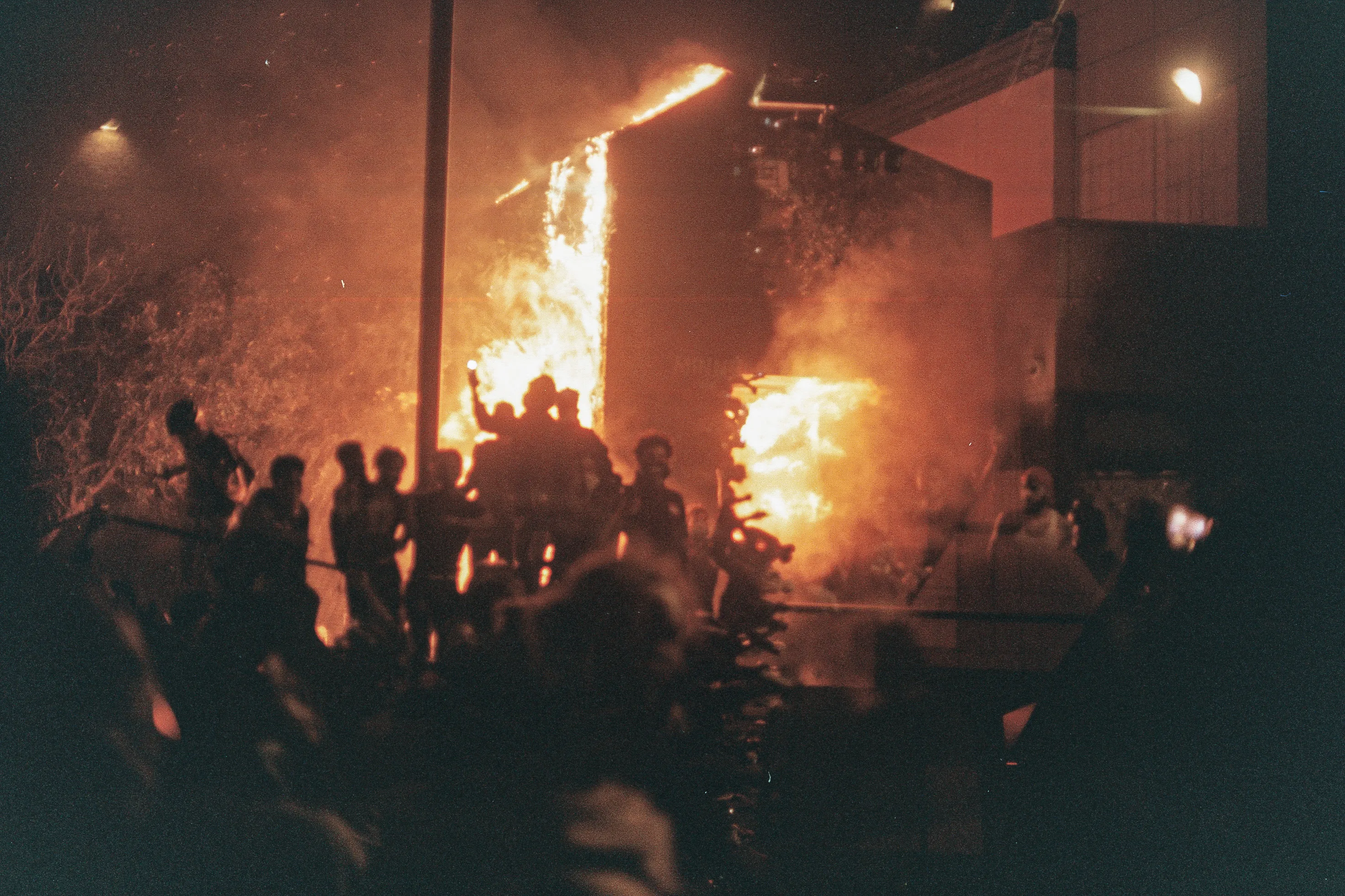
These are just some of the names of the people who have been under the yoke of the state since the summer of 2020, when people rose up for an end to police murder of Black people and an end to the police themselves. In some places the rebellion burned hot and fast. In other places, it smoldered, reigniting for months after if not years. Regardless of how long or how hard people went, carceral state repression and recuperation followed. From our perspective, the uprising isn’t over until the last rebel comes home. With this in mind, supporting the many people still locked up from the 2020 Uprising is not just an ethical imperative for anarchists, it’s also how we build strong movements that can withstand state violence and thrive.
You can find out more about how to support prisoners from the George Floyd Rebellion at www.uprisingsupport.org
Footnotes
-
No listing of political prisoners is comprehensive, but the NYC Anarchist Black Cross maintains a guide that comes close. For reasons of space, we recommend readers check out their work: https://nycabc.wordpress.com/ ↩