Red May Theses
Drawing on the examples of the Paris Commune and 20th century workers’ councils—'the only new invention of the communist movement in the 20th century'—Bernes distills their successes and failures into a description of communism that is at once abstract and practical

Drawing on the examples of the Paris Commune and 20th century workers’ councils—“the only new invention of the communist movement in the 20th century”—Bernes distills their successes and failures into a description of communism that is at once abstract and practical. If the piece begins by enumerating the qualities of the revolution, it ends by sketching an outline of communism itself—common production for common use, planned via transparent and tractable mechanisms available for and accountable to all.
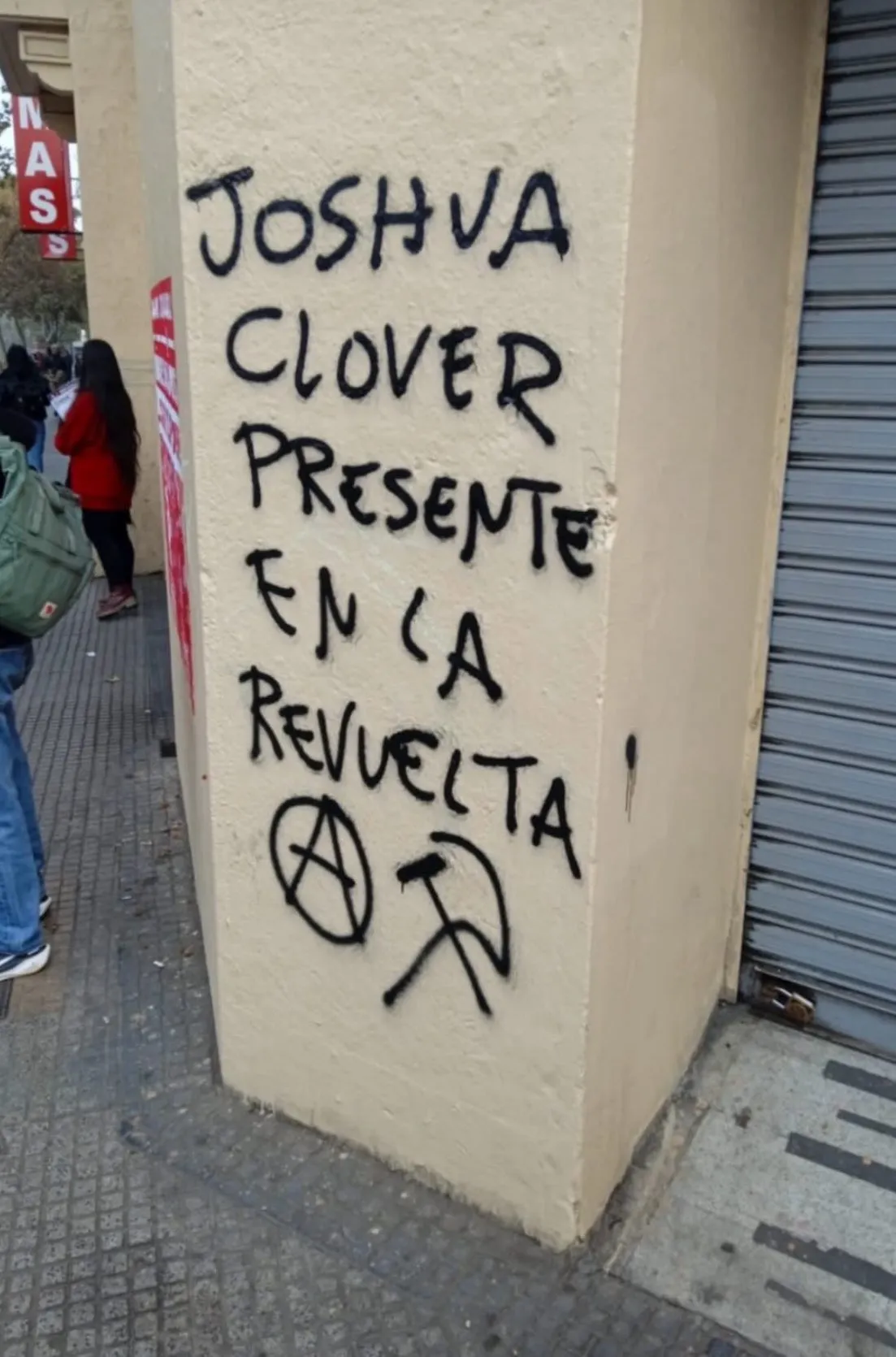
In memory of Joshua Clover
-
The first condition of revolution is the destruction of the repressive state—army and police, judiciary and prison. All other conditions depend on the first: socialization of wealth by the revolution can only occur to the extent that the repressive apparatus has been suspended. From the looters in a riot to common production for common use, communism advances as property and its violently enforced right recedes.
- 1.1. As the state is disarmed, the revolution is armed. But the powerful few are not the same as the weak many. Insurrection and state are asymmetrical. The revolution succeeds by dispersing rather than concentrating state violence. Frontal confrontation between the party of chaos and the party of order always leads to the reimposition of order. The eclipse of the state proceeds through desertion, mutiny, and fraternization between the forces of order and chaos. Fight against the drawing of lines, it reminds us, by fighting behind the lines.
-
The breakdown of the state is only the gateway to revolution. Revolutions are social and not merely political insofar as they are revolutions of the vast majority of humanity, the proletariat. The vast majority cannot become a new power over society, for then it would simply exploit and dominate itself, a contradiction in terms. It must abolish exploitation, domination, and all classes. This is therefore the second condition: the revolution must be massive, its organizations must be organizations of the vast majority, the proletariat. They must be universal except for this condition. They disallow elites and their enforcers but are otherwise unrestricted by any other social category or identity.
-
2.1. The structures of revolution therefore must comprise, at least potentially, everyone. They must be both intensive, rooted within the fundamental structures of daily life of the common people, and extensive, linking people with others at a distance. Since the human species cannot be concentrated in a single location, such structures must also coordinate common action at a distance. They must delegate. However, since inclusivity is a first requirement, these delegates must be given explicit mandates and their decisions made revocable at will. Authority is both given and retained and therefore held in suspension. This is the third condition.
-
2.2. There must be no difference between delegates and their delegators, which means that delegates serve for a limited period, and their work is simplified and rendered transparent to all. Where expertise is required, it is advisory. These must be working bodies, not governmental ones, both political and economic at once and neither, abolishing the division of labor between execution and conception, manual and mental labor, that structures capitalism.
-
2.3. These structures presume the abolition of police power. The arming of the proletariat, of the vast majority, means that violence can only ever be directed outward, against the enemies of the revolution, and not inward as a backstop to the revolution. Directed inward, such violence violates the first and second conditions, reconstituting the police power of the state and excluding the majority from participation.
-
-
We can name this collection of three conditions the commune, inasmuch as the postulates outlined above correspond to what Marx, writing about the Paris Commune of 1871, calls the commune-form. This is a “thoroughly expansive form,” as Marx wrote, plastic and scalable. The commune is fractal, self-similar, exponentiating across any social distance, assigning delegates to delegates as needed. This expansivity means that it projects a future—it is both actuality and idea, actuality calling by way of idea to further actuality. In this way, the commune is not confined to a place or time but is universal. As a fragment of a future communism, it rallies communists around the world to its side. Its borders do not coincide with any nation, for its black flag spells death to the nation-state.
-
3.1. The commune is, however, ambiguous, amphibian—as an expansive form its content remains unspecified. If simply a structure of direct democracy, it can easily become vehicle for the reproduction of capitalist social relations. Who composes the commune? What does it do? How? And why? These are questions to which history poses an answer with the soviets and workers’ councils that appear first in Russia in 1905 and then again in 1917, and in 1918 and 1919 across central Europe.
-
3.2. The historical workers’ councils have a content restriction—a restriction to proletarians—because they are transitional products of the mass strike, a class-wide proletarian action that exceeded the control of the institutions of the workers’ movement (parties and unions) and therefore required an extra-party instrument. During the German Revolution, participants were sometimes asked to show an employment card as evidence of proletarian identity in order to join. After the councils were defeated from within, voting to abolish themselves, many concluded that it was because non-workers were allowed to participate and become delegates, bringing many of the councils under the control of the unions and parties. It was necessary, they concluded, to ensure the proletarian character of the councils.
-
3.3. But because the mass strike moves inexorably toward insurrection, these organizations for the conduct of the strike make plans to depose the police, to occupy the government buildings and the newspapers. As soon as they silence the machinery of capitalism, they also quietly maintain services vital to the revolution and to the reproduction of the vast majority. They keep the power station running and print newspapers with headlines announcing the revolution. To the proletarian content restriction, we must add a communist one. The councils must expand to include everyone and everything in a common plan to provision for common use. They must abolish production for profit and with it the commodity, money, and the law of value through common production for common use.
-
-
Thus, the workers’ council: the only new invention of the communist movement in the 20th century. All else since can be seen as a refinement of the council-form as it supersedes the commune-form. But here again we need to distinguish between the council as actuality and the council as idea. In actuality, as I indicate above, the councils were not entirely proletarian instruments. But more importantly, the councils lacked a functional content restriction—instead of becoming avatars for the extension of the revolution and the socialization of wealth, delegates were reduced to electors for a national assembly, re-constituting the German state as a parliamentary democracy. In order to be revolutionary, the councils needed to be both proletarian and communist. They needed to be oriented toward the reproduction of the revolution, and the absorption of the vast majority, thereby abolishing all classes and with it the proletariat as a dominated class. This can only happen to the extent that such organizations are engaged in the destruction of generalized commodity production and its replacement by common production for common use.
- 4.1. With these restrictions, the councils make clear what is meant by the “dictatorship of the proletariat.” Certain people are excluded as a matter of first principles—unless they relinquish the powers conferred upon them by capital and the state. Nor are these democratic, constituent bodies. They are communist by definition and presume a communist unanimity.
-
From this principle one can derive a limited definition of the party—not a formal organization, per se, but that grouping within the self-organizing councils which is oriented toward insurrection and common production for common use. These are aspects that cannot be put to the vote. The party is also, in moments of insurrection, a red army, an army whose unity is emergent rather than imposed. The red army is self-constituting, volunteerist. Its officers are chosen not imposed and have no special privileges. Its structures of centralized decision-making last only for the length of armed confrontation. This is in fact a model for communist organization broadly through the councils—it is no problem to temporarily designate a decision-maker within a particular process, or to establish automatic procedures for certain actions. Not everything has to be deliberated.
- 5.1. The army levels and expropriates, abolishing the rule of property and its armed guards. It abolishes class but it cannot abolish itself except by giving way to freely associated producers related to each other through transparent, tractable mechanisms.
-
Council communists imagined this early stage as constituted by “ruthless enforcement of the compulsion to work,” something that cannot be achieved except by the reconstitution of the repressive state. Where labor is both obligation and right, where workers can only be sent somewhere else and not starved to death, workers cannot be made to work with concentration or care. Those who do not want to work effectively cannot work and any activity is better off without them.
- 6.1. But the councils might instead socialize rather than individualize necessity. Some things must happen—call it work, labor, reproductive activity—if everyone is to be fed, housed, provisioned. But we need not restrict access to food and housing in order to ensure these things happen. That part of total output devoted to production of essential goods and services is now a small portion of overall economic output. More of these essential goods and services can be produced with less effort than capitalism presently mobilizes if unproductive activity related to the capitalist mode of production—cops, defense contractors, bankers, bureaucrats, brokers, advertisers, and insurers—were eliminated, along with luxury production for the consumption of elites. There is no longer any need to individualize necessity. It can instead be immediately socialized.
-
The immediate socialization of necessity and social wealth requires forms of accountability that are transparent and tractable to all. People account for each other by accounting for things. Social reproduction takes place in part through processes that are openly and transparently planned and accounted for—the numeric figures corresponding to such processes are made visible to all and tractable through open, inclusive decision-making processes requiring no specific technical knowledge.
- 7.1. This does not mean, however, that everything can or should be planned deliberately. Planning also means, by definition, leaving some things unplanned; all planning is planning for anarchy, for the unpredictable, the unscripted, the spontaneous, and free.
-
The maxim of communist human community is free development both individual and collective. Everything is permitted except that which hinders free development. A puzzle that can be solved in hundreds of different ways, through the cultivation of subjectivities and forms of life scarcely conceivable now.
-
Necessity is socialized and therefore rendered free. Humanity finally decides freely how to organize its metabolism with nature—it transparently organizes itself in response to natural necessity. As necessity is rendered free, freedom becomes necessary. We therefore cannot speak of communism as containing, on the one hand, a realm of necessity, and on the other a realm of freedom, with the first corresponding to social obligation, compulsion, or requirement and the second a lack of all responsibility. Rather there is a realm of planning, of deliberate, collective accounting, and a realm of anarchy, of free and unscripted activity. All activity is organized but not all activity is organized in advance (planned). Both realms might involve freedom and necessity in varying degrees. For some individuals, perfecting technical processes involving deliberate collective work might be the purest expression of their freedom, of a situation in which labor has become life’s main want. For others, ethical, spiritual, and aesthetic cultivation instead defines their reason for being, but even this is likely to involve discipline, rigor, obligation. As the opposition between the individual and the collective dissolves, so too does the opposition between freedom and necessity.
-
Communism is the end therefore not just of capitalism but of class society as such and with it the end of the metabolic rift between humanity and nature, the end of the Neolithic counter-revolution known as civilization—not a return to the dynamic equilibrium between humanity and nature of prehistory but the establishment of a new dynamic equilibrium, likewise open-ended and infinite, that must contend with the long shadow of industrial capitalism. The maxim of free development extends beyond humanity to all of nature. Communism is a dynamic equilibrium between the free development of humanity and the free development of nature. This allows us to distinguish between the value of a lawn and old-growth forest. Of course, what constitutes the free development of nature will have to be freely decided by humans. There is no single perspective in and as nature that can guide us—the wolves will want something different than the dolphins. Instead, communism will reenchant the world, treating everything as potentially a person, as capable of development. We will at last recognize the built environment as a collaboration between our ancestors and nature with our free development as its aim. No longer will dead labor dominate us as capital—rather, the world built for us by our predecessors will guide our way out of the violence of prehistory and into true human history, no longer a story of necessity against freedom but freedom as necessity. Communism might last a million years.
May 29, 2025 Seattle, Washington
Jasper Bernes is the author of The Future of Revolution: Communist Propspects From the Paris Commune to the George Floyd Uprising.