Treatise for the Youth in Revolt
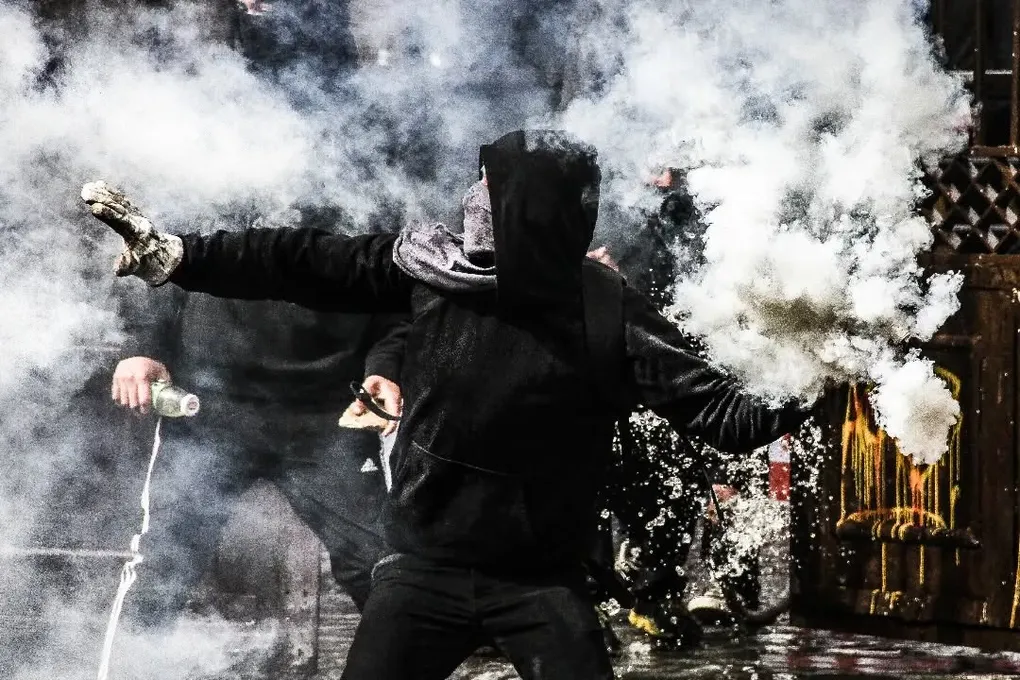
Five years later, 'Treatise for the Youth in Revolt' offers an incisive reinterpretation of Chile’s 2019 uprising. What began as mass fare evasion by the student proletariat propagated across neighborhoods and cities to target all avatars of capitalist “progress” and “development,” from police stations to mining infrastructure. The text traces the insidious domestication of the revolt through the fetishization of student protagonists, the blind imitation of tactics, and its persistent characterization as a 'social explosion'
July, 2025
We need to provide context for international comrades1. Between October 18th, 2019 and early 2020, Chile experienced a wave of social mobilization that marked a turning point in its recent history. What began as mass fare evasion in Santiago rapidly became a national revolt. Within days, millions took to the streets, expressing decades of discontent with a neoliberal model inherited from Augusto Pinochet’s dictatorship (1973–1990), a discontent that had only deepened during the democratic transition.
October 18th marked the beginning of the revolt, which was much more than just a “social explosion” (Estallido Social)—a term widely adopted by the media and political sectors to strip it of political meaning. Unlike “social explosion,” which implies chaos and spontaneity, the concept of revolt—as developed by authors like Alain Badiou or Kristin Ross—points to a popular eruption with deep subjective, political, and social resonance. A revolt interrupts the given order; it doesn’t follow a singular cause or reduce popular movements to one demand. It is the moment when the intolerable is no longer tolerated.
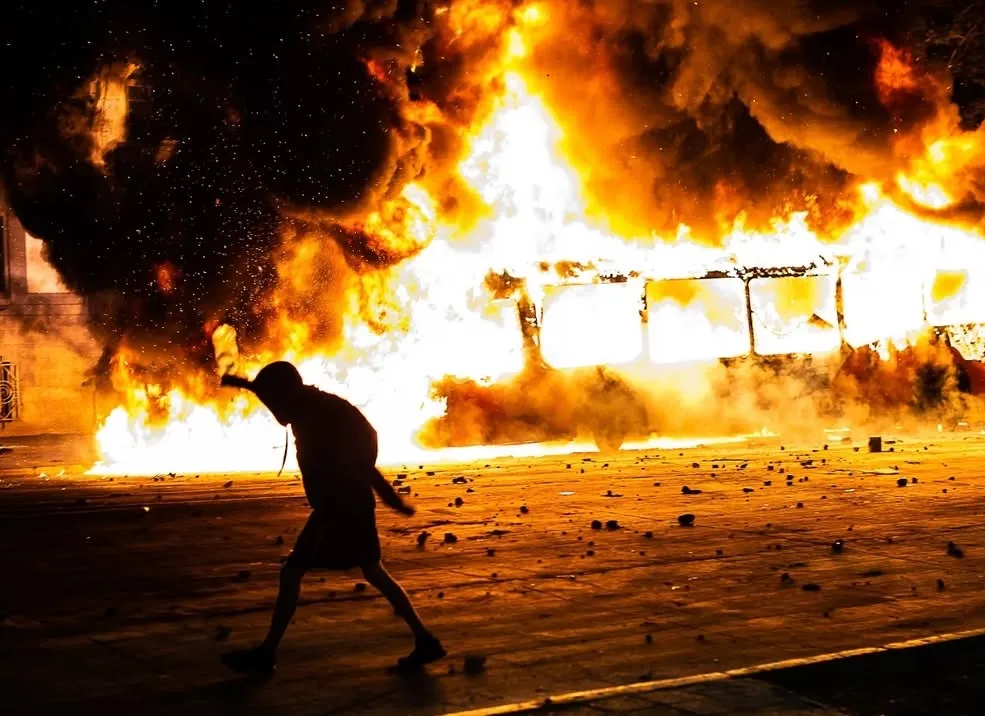
Faced with massive protests, Sebastián Piñera’s (then president of Chile) government decreed a State of Emergency on October 18th, followed by an unprecedented curfew. Military presence on the streets and serious human rights violations—documented by national and international organizations—defined the first days of the revolt. Rather than quelling the unrest, this repression escalated the conflict.
On November 15th, 2019 (15N), aiming to channel the crisis towards safer institutional outlets, the main political parties in Congress—including current reformist president Gabriel Boric—signed the “Agreement for Social Peace and the New Constitution,” excluding social movements and victims of repression from the process. This deal called for a plebiscite on a new constitution, launching a constituent process that was later neutralized by several factors: traditional party control, a restrictive institutional design, and growing demobilization amid conservative restoration.
In March 2020, COVID-19 hit Chile and the world. Lockdowns and fear of contagion were mobilized to suppress protest. Yet the pandemic also exposed deep-rooted precarity—chronic debt, privatized healthcare, unemployment, and informal labor. The revolt didn’t disappear; it shifted into everyday resistance, community organizing, and systemic critique.
More than five years later, and after a failed constitutional process that left open wounds, we continue to resist efforts to reduce the memory of the revolt to the so-called “Social Explosion,” an interpretation of events laundered widely by those in power. This text aims to preserve the living memory of a revolt that still pulses beneath the surface of everyday life for all Chileans.
October 18: Fracture of the capitalist social relationship.
Conscripts of good will,
ours will be a ferocious philosophy;
ignorant as to science, rabid for comfort;
and let the rest of the world croak.
This is the real advance. Marching orders, let’s go!
Arthur Rimbaud, Democracy.
The events that began in October 2019 were part of a global circuit of struggles that included the Hong Kong rebellion, the Sudanese Revolution, and the Yellow Vests in France. Our attempt to understand its cause comes not merely from a leftwing urge to vindicate the revolt, but from the need to clarify the nature of the uprising and its real scale, including the role of the youth in the crystallization of a generalized crisis. Perhaps even more importantly, we want to understand the recuperative forces of capitalism, which were intimately related to the outcome of the revolt and the immediate response to it from the sectors that make up the macabre body politic defending “public order.”
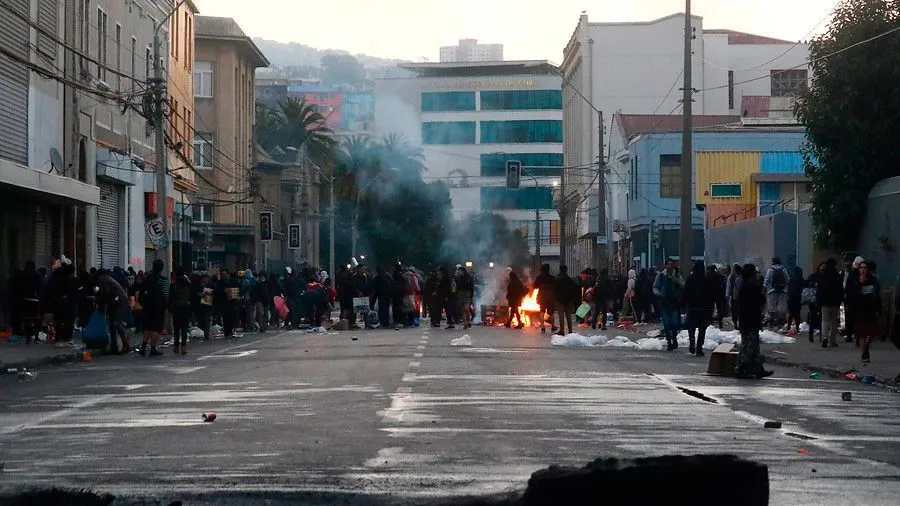
However, we are faced with the mythification of certain moments of the Chilean revolt and its protagonists, giving it an unreal and at times overdetermined interpretation. Without wishing to downplay its significance, we believe that the events of October 18th have been interpreted in a way that tends to give them a more revolutionary character than was actually the case. This is especially true regarding the subway evasions, an important milestone that quickly generated an ambivalent reaction among the “professionals of the show” (columnists, journalists, and parliamentarians), many of them making use of such ambiguous concepts as “delinquency” and “civil disobedience” to capture or criminalize it.
As Julio Cortés relates in a lucid article on the matter, Gabriel Boric, at that time a Congressman who built his public persona on “anti-capitalist” aesthetics, defended the turnstile jump in tweets and interviews.2 Today, he would be ridiculed. Why is it that subway dodging was to some degree so vindicated in the initial narrative of the revolt by left-wing parties? And more importantly, what was so special about the subway evasions that they escalated into a nationwide revolt, if we assume the premise that this was indeed where it began?
The narrative sustained by the leftwing parties presents the turnstile jump as the greatest democratic milestone since the pseudo-transition to democracy after the end of Pinochet’s rule in 1990. This obviates its real character and historically isolates it, thereby turning it into mere symbolism. If this were only an act of youthful disobedience permitted within the legal framework of the status quo—which it was not—it would have culminated in nothing more than a passing headline on the evening news. The revolt’s historical significance does not come from this particular form. We can trace the form back decades; the mass non-payment of fares was already present in the protests during the “Batalla de Santiago” (Battle of Santiago) in 1957. In truth, this evasion attempted, perhaps unintentionally, to overcome the process of capitalist valorization. It represented the collective abandonment of money in pursuit of free association, even if temporarily.3
Chanting “Evadir, no pagar, otra forma de luchar!,” (Evade, do not pay, another way to fight!) the youth proletariat, superficially at first, aimed its criticism at capitalism directly. This focus was later amplified and intensified in different regions, where collective activity acquired a content more situated within the realities and contradictions that materialize from extractivism, the abrasive design of the cities, and local crises of reproduction. In these regions, social conflict threatened different forms of the Chilean export engine (e.g., against forestry and mining industries). Given rampant workplace sabotage, burning transportation infrastructure such as public buses, the seizure of land by the Mapuche movement, and the occupation of high schools and universities by students, the backlash was not surprising and came in the form of widespread media condemnation, intensified legal crackdowns, and violent repression.
The repression suffered in the first days of the evasions and protests by secondary students is essential to understanding the intergenerational character of the struggle. If there had not been the excessive response on the part of the government and the interpretation of the social body as an “internal enemy,” the revolt would not have generalized. During the most radical moments there was no prospect of reconciliation—it was openly expressed as social warfare. A “realistic goal” had to be created in order to suppress the revolt, because no such goal existed.
The media’s condemnation of all forms of protest that moved beyond inane electoral rituals or other equally futile appeals to power—campaigns to collect signatures to stop the extinction of a species or industrial pollution, to give some crude examples—culminated with the legal proscription of anything too disruptive. In other words, “everything that could have been even the least bit effective is forbidden.”4 The mass fare evasion celebrated by the Chilean left at the beginning of the revolt was by its nature an “anti-democratic” protest movement, a revolt against bourgeois rights and the democracy which exists to legitimate it.
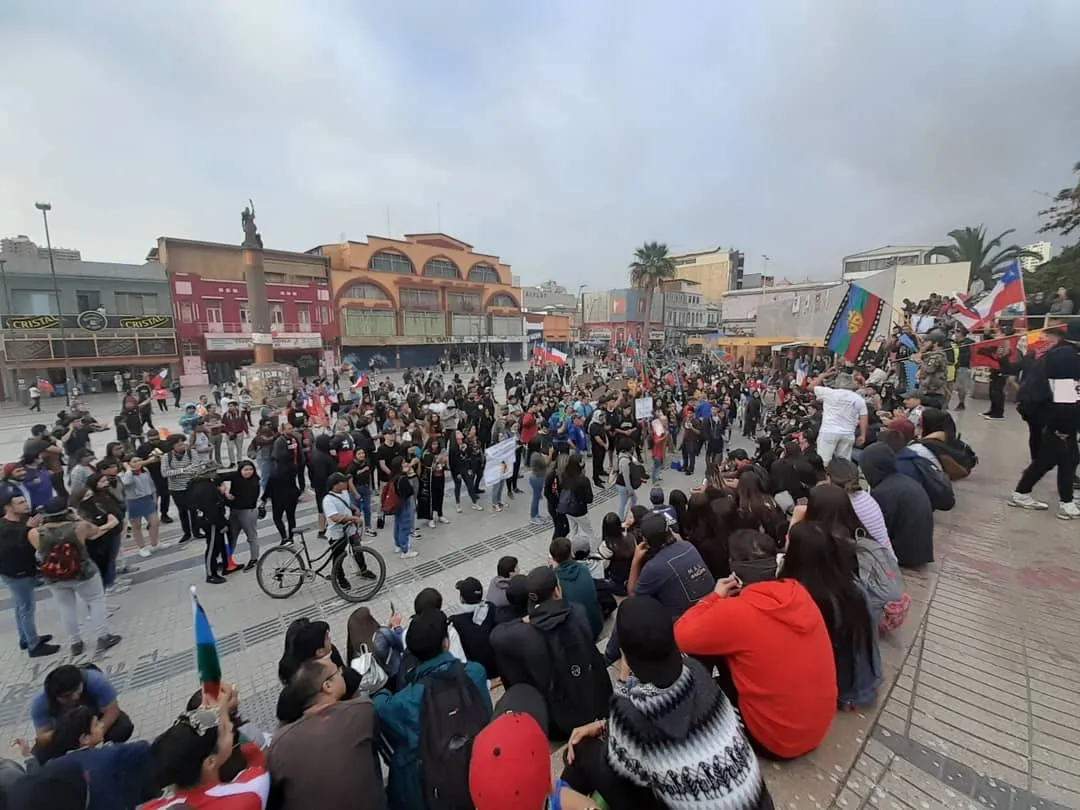
The effectiveness of hopping the turnstiles was not just because of fare evasion, but because of the action’s virality. The rapid dissemination by the media—formal and informal—of the subway fare evasion spectacle, coupled with the collective rejection of police brutality against the youth, quickly spread the spirit of the revolt. It moved through every generation, spreading the action to other places outside Santiago that also had metro systems, such as Valparaiso. However, the act of jumping the turnstile itself was quickly surpassed, and by October 19th the protests had reached places without metro systems. In the early days of the revolt, the most noteworthy feature was the speed with which both the place and the practice itself overflowed. The protest went viral and suspended historical time, and in its course revived vestiges of previous cycles of struggle.
The different conflictual forms that emerged in the days following October 18th needed no explanation; those actions meant something to each of us and inspired us to a degree that had not been felt in a long time. The initial spontaneous actions among students were soon followed by coordinated autonomous and decentralized demonstrations against the capitalist order, from mass walkouts among high school students to serpentine marches, looting, and tumultuous confrontations against the police and the military. The prolonged nature of the uprising made it necessary to acquire and generalize basic logistics to confront repression. This included the use of certain clothing, the manufacturing of “shields,” encrypted communication, and physical preparation.
The effectiveness of the turnstile hopping tactic gradually wore off. It was eventually superseded and complemented by other measures around the country. In the case of northern Chile, Antofagasta joined the protests the following day and quickly became one of the main centers of struggle. In the neighborhoods of Miramar, Bonilla, and Cachimba, clashes against the police continued until long after the protests died down in the rest of the country.5 It was precisely this extension to other cities across Chile, alongside adoption of forms and discourses different from those originating in the capital, which ensured that the first protest would generalize into a full revolt imbued with the “forces of drunkenness.”6 Having reached a certain maturity, the revolt, still lacking a head and with a cross-class composition, exceeded the classical categories of revolutionary subjectivity. It generalized throughout its body—or multiplicity of bodies moving to a common rhythm—a new collective sensibility that propagated new forms of organization, aesthetics, strategies, and ways of inhabiting/perceiving/configuring the world against and beyond the ruins.
The adoption of the turnstile hopping tactic by the reformist leftwing party vanguard (Frente Amplio and the Communist Party, which currently form the government) and the creation of an official narrative would serve to recuperate this initial moment of upsurge. This recuperation is evidenced by the repetitive use of images depicting the subway evasion in Santiago for the “Apruebo” campaigns and even in advertisements for several companies.7 This romantic retelling centers youth as its protagonist and denies—or is unable to caricature—the major instances of intelligence and solidarity in the wider general rebellion: forms of self-organization and mutual aid that emerged from the barricades, direct action, and the collectivization of commodities after the widespread looting of supermarkets and pharmacies. These were the first conscious attempts to overcome some of the essential aspects of the capitalist order and the law of value.
As shared in a report on the advance of the revolt in Northern Chile by El Sol Ácrata,8 the protestors did not need to look for reasons to take to the streets, because these had been obvious for years. The revolt in various sectors took the form, above all, of an assault against the capitalist way of life that had us submerged in a miserable existence. We highlight the experience in “sacrifice zones” such as Calama or Quintero, where the protest took on a character that attacked the concepts of “progress” and “development,” ideological avatars of capitalist industry, especially mining.
The fetishization of tactics results in their artificial repetition, worn out and temporarily emptied of content. This was the case, above all, of the different forms of militant action found within so-called “combative” territories, neighborhoods that became emblematic for their constant resistance against the repression of the military and police. Over time, confrontation was limited only to these areas and was unable to spread. At a certain point, unreflective repetition—rituals of self-destructive violence, which ultimately functioned to justify the repressive policies of the state, and more specifically, the persecution of protesters—led to an inability to expand outside of these neighborhoods.
The mere imitation of tactics will not reproduce the revolt, except in a farcical form. The movement must regenerate its subversive potential, which means thinking up new strategies, reinventing forms of organization, reimagining collective technique and practice conceived as an overwhelming attack on the basic relationships that structure the capitalist world. Thus, calling for a “return to jumping the turnstile” or urging a mechanical repetition of the cycle of revolts of 2019-2022, although it sounds good on paper, is practically useless and amounts to nothing more than a slogan. At best, “jumping the turnstile again” is a call to reactivate the tactical forms that generated the first moments of the revolt, but risks overemphasizing the gesture itself.
Counterinsurgency, response to the Chilean revolt
The revolt, especially since the 15N Agreement (so-called “Peace Accords” of November 15th, 2019), has been reduced to its most inoffensive moments.9 The evasion is partially accepted as a “just” action insofar as, in the long run, it was separated from its initial content and the confrontations, sabotage, and other insurrectional moments that endangered strategic infrastructure, police stations, and the daily commute of workers to and from work. The fetishization of its protagonists—students—is not harmless, but in fact vindicates the most reactionary character of the rebellion and the spearhead of the modernization process of capital since the early nineties.
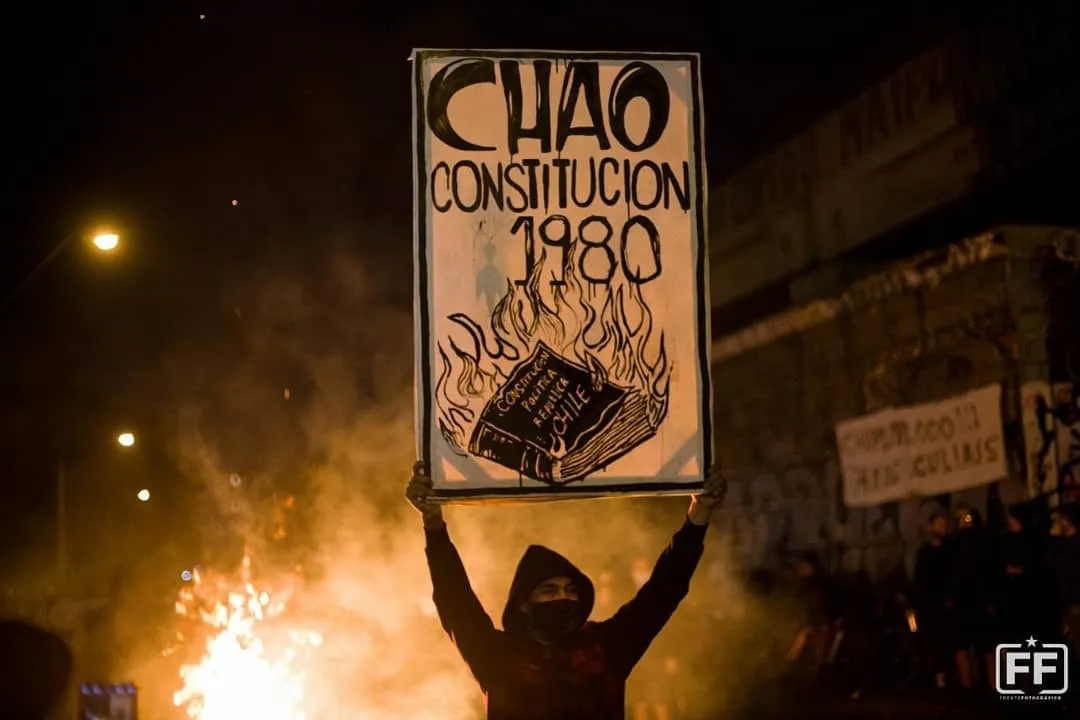
The student body, be it secondary or university, is the subject-form par excellence of advanced capitalism. As “heirs of the classic workers’ movement, or even configured in its image and likeness,”10 they replicate its same limits and errors. There is no modern subject that more frequently advances towards the same dead end than the student movement, with a program perfectly integrable to the capitalist system, headed by those who will be the next administrators of capital. The nature of the Chilean student movement is ambivalent: always at the forefront in the dispute for the distribution of the fruits of the capitalist system, as well as the most radical and intransigent opposition to the spectacular order. This ambivalence has been recurrent for decades, emerging most acutely in the 2006 and 2011 iterations of the student movement.
If the proletariat has historically tended to fight for recognition within the system, the student movement—and youth in general—is a corollary of the unstable identity of the proletariat, “characterized by a self-critical, ‘tense’ and necessarily ‘uncomfortable’ quality, at once subject and object, commodity and commodity owner.”11 Breaching the turnstiles can be seen as the ultimate limit of how much capital and its administrators would concede in constructing the official narrative about their undeniable crisis. Within the new narrative, the media face of the Estallido Social (social explosion) is reduced to harmless moments against institutional excess.
The process of restructuring capitalist social relations occurred through the double mediation of parliament and the street. What emerged was a fantastic discourse on the capacities of democracy, constituent power, and the “cabildos,”12 that served as a preview of what would become the death of the revolt. Just as the movement was timidly beginning to think of itself as a revolution, the death knell of the revolt came with the 15N Agreement, the constituent process and, finally, the presidential election.
The restructuring was at the same time a spectacle. At a relentless speed, the public was bombarded by the media and major parties until it gradually accepted the narrative of the system and its reconstructed reality. Meanwhile, the rest of the industries engaged in production of the spectacle—television, cinema, publishing—created a generalized climate of insecurity that was used as a justification for the repressive and populist policies of the conservative parties, although finally adopted by the Left™, in order to justify their repressive measures against the insurgent remnants of the revolt (anarchists, the Mapuche movement, students, etc.).
The constitutional change was a mechanism for capturing the movement. Since the 1990s, counterinsurgency has had a reliable method for transferring struggle to its playing field: democracy. The Constituent Assembly served as a filter to separate the revolt into extremists and moderates, between those who supported the struggle for a new constitution and those who rejected it. The disease of assemblyism was already present in 2006, and by November 2019, the main left-wing parties had dusted off their slogans in favor of constitutional change. However, their aspirations of transforming the capitalist order concealed the desire to be part of its management.
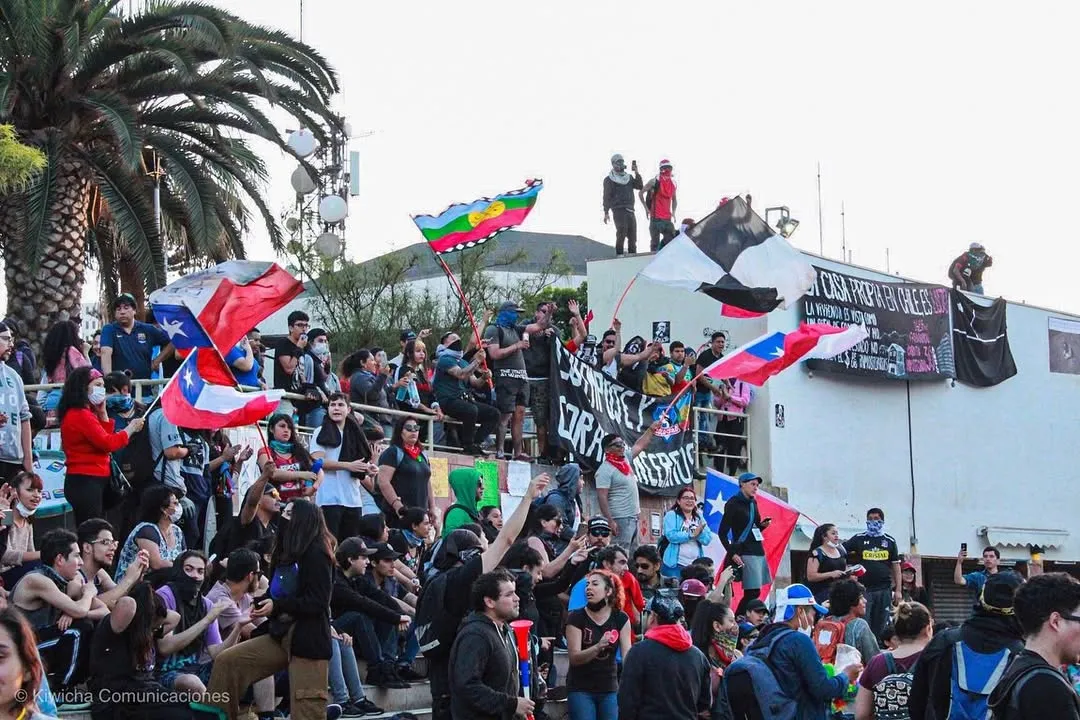
Faced with a process that was undermining the entire liberal democratic institutional system (polls at the time showed a disaffection with everything involved in it, including Congress, the president, political parties, the police, etc.), the only response was… more institutionalism. The constitutional convention that emerged from the “Agreement for Peace” of November 15, where the ruling party and most of the opposition parties—with the exception, initially, of the Communist Party—met with the supposed aim of solving the problems that the uprising had brought to light, but which, as we well know, were not achieved, if indeed they were ever attempted. Rather, its success was in making change no longer “desirable,” specifically in having formally failed; four years after the uprising, the situations it brought to light are not the same, but worse. There is an inability on the part of democratic sectors to fully understand the problem, an inability that can be perfectly understood but at the same time denied, because accepting that no solution can be found within the margins of liberalism and capitalism means accepting that both must be overcome in pursuit of a world beyond the state and the market.13
In this narrative, the constituent process and the current government are rescued while everyone else gets criminalized under the rule of law.14 The narrative surrounding the protest today is also the argument to subdue any spirit of revolt through the coercive, violent, and institutional force of the state and its private supporters. It reduces the political significance of the movement to a process of generational and aesthetic modernization and dissolves any possibility of repeating October 18th—at least in the same way it originally occurred.
Revolt and Revolution.
The protests were an expression of generalized misery, despite their difficulties and limitations. They revealed “the ineptitude, now proven, of the economic vision of the world by not capturing anything of human reality.”15 The recognition of a discomfort embedded in the heart of the democracy-dictatorship of capital—or, rather, that discomfort which is democracy itself—was first manifested on a large scale several years after the civil-military dictatorship, translating into indignation and protest against domination in general, and specifically against a state of affairs that was denied and disavowed.
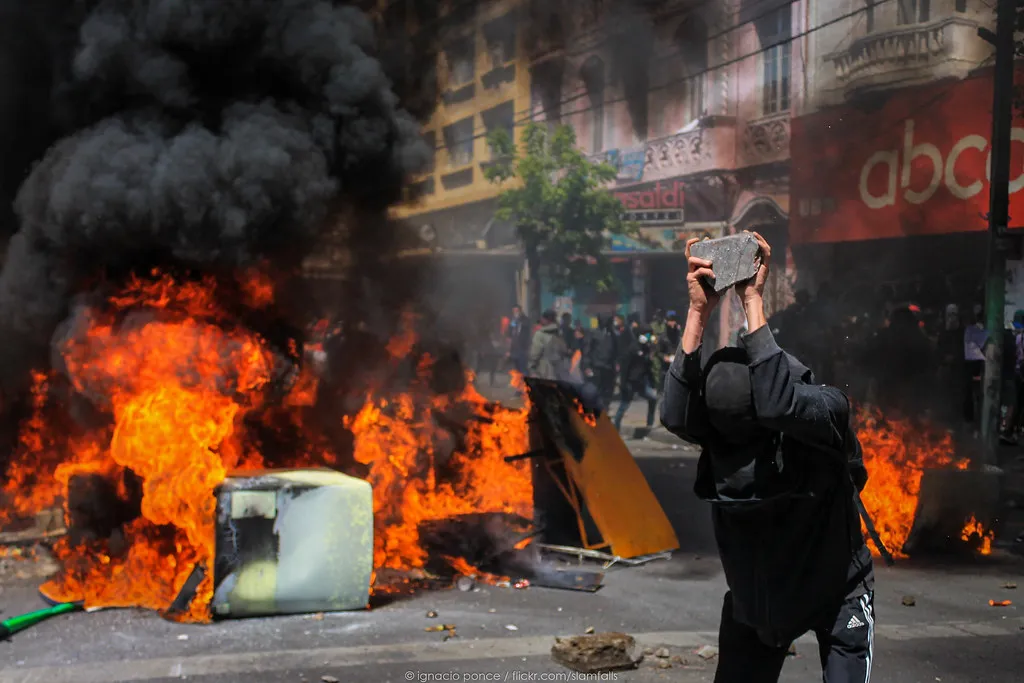
The advance of the revolt briefly broke the felicitous illusion of stability and progress that had been imposed during the dictatorship and had continued efficiently with the Concertacion (a coalition of center-left parties), that inverted image of capital and the democratic order that hides the sobs of the oppressed creature.16 The lie lies to itself by becoming true. The perpetuity of capital clarifies its vital truth: its need for illusions. That great carnival of farces is translated into the fantastic dominion of the world in the form of the economy. The elimination of these illusions is a precondition for any emancipatory project that seeks to put a brake on capitalism’s drive towards extinction. The dissipation of the mist in the leading aspects of the protest momentarily turned into absolute negation, becoming-conscious.
Judith Butler conceives of revolt as a rising up, the act of ceasing to lie face down on the ground, to shake off the dust and the leaves,17 a form of collective embodiment of rage and indignation that takes a step beyond to the systematic recognition of its causes and the movement against them. But Butler’s definition may be problematic, since it seems to reduce revolt to a temporary opposition to forms of domination that always tends toward failure, thus configuring failure as the very essence of all revolt. What would differentiate revolt from a mere protest? What would be a revolt that succeeds? More than an irremediable destiny, the revolt, independent of its resolution, is a moment in the becoming of the revolution and, although its historical tendency may contain failure, it does not deny the possibility of its success.
The restriction of these categories to a narrow set of situations and methods makes “revolution” seem impossible. The main distinction drawn between revolt and revolution is usually centered, broadly speaking, on the failure or triumph of the uprising, ignoring the character of the uprising and its content. The reduction of the revolution to its result (triumph), condemns it to be historically only a recipe for a successful coup d’état in the manner of the Russian and French cases. The triumph of the revolt can be nothing but the possibility of the revolution,18 when the roads open and the revolution approaches not as a destiny, but as a reality. The revolution is communism making itself without “transition.”
The latest wave of global revolt, however localized and superficial some of its expressions may have been, was characterized by a tendency towards interconnection. Revolt always has a historical content, through which a line can be traced between the echoes of each action of rebellion and collective opposition. Each local revolt left a small signal to locate the next ones. Their defeat will always be partial; from failure and barbarism extends a historical legacy that gradually accumulates an enormous common account of experiences, tactics, and methods of struggles.
Spread throughout the world and history, revolts are cited among themselves; localized, but never isolated; interconnected, but never decontextualized. Though by themselves they were no more than “small episodic events, slight fractures and fissures in the hard crust of society… [Together] they were enough, however, to reveal the abyss that lay beneath. They showed that beneath that surface, so solid in appearance, there were real oceans, which only needed to be set in motion to blow into pieces whole continents of hard rocks.”19
All these planetary milestones, which form a world constellation in acephalous, decentralized and unfocused mobilization, were not destined to result in failure. Present and future movements will not drift towards their irremediable defeat, but to an unknown horizon. Although the uprisings have repeatedly crashed against the limits of traditional political systems, rather than betting on their destruction and overcoming, nothing prevents the uprisings from becoming revolution. We must think about revolution based on the limits that determine its possibility today—that is, the way revolution can now overcome its obstacles and take shape as reality.
Colapso Y Desvio is a collective project for writing and disseminating radical theory, created by communists in Chile. Read more about them here.
Footnotes
-
The following is an updated translation, partially excerpted from the book Tratado para las juventudes en sublevación ↩
-
Julio Cortés, “La dialéctica en suspenso. Revolución y contrarrevolución en Chile, a tres años del «Estallido Social»,” 2022. ↩
-
A pamphlet in circulation since 2018, understood the turnstile as “the symbol of the misery of this capitalist system,” containing “the true spirit of this false community, it is the image that sums up our whole non-life: pay to live, live to pay.” Comunidad de Lucha N°3, “Salto del torniquete de la no vida,” March 2018. ↩
-
Anselm Jappe, Crédito o Muerte, Ed. Pepitas de calabaza, p. 74. ↩
-
This resulted in the longest conviction of a political prisoner. This is Deivy Jara, 19 years old, who was sentenced to 12 years in 2023, having already served 2 years in prison prior to his conviction. ↩
-
Walter Benjamin, “El surrealismo. La última instantánea de la inteligencia europea,” 1929. ↩
-
Apruebo Dignidad (Approve Dignity) was a democratic socialist Chilean electoral coalition created on 11 January 2021 ↩
-
El Sol Ácrata, Año VIII/Segunda época/N°5/ octubre de 2019. Véase
en: https://periodicoelsolacrata.files.wordpress.com/2019/10/el-solacc81crata-octubre-revuelta-de-2019.pdf ↩
-
On November 15, 2019, most parties signed the “Agreement for Social Peace and the New Constitution” (N15). The N15, negotiated behind closed doors, committed to writing a new Chilean constitution. ↩
-
Círculo de Comunistas Esotéricos, “Un largo octubre: Notas y apuntes sobre lo que abre y cierra octubre de 2019 en Chile”. ↩
-
M. Bolt & D. Routhier, Critical Theory as Radical Crisis Theory: Kurz, Krisis, and Exit! on Value Theory, the Crisis, and the Breakdown of Capitalism, 2019.. ↩
-
The cabildos were local governing bodies established during the Spanish colonization of South America, representing Spanish and Creole (criollo) elites (primarily aristocrats, clergy, and military officials) and overseeing city administration. In Chile, the Cabildo Abierto de Santiago in 1810 marked the beginning of the independence process, serving as a transitional governing body. During the 2019 “Social Outburst,” the term ‘cabildo’ was reclaimed to describe self-organized citizen assemblies, where social demands and the drafting of a new constitution were debated. ↩
-
Jesus Díaz and Bastián Venegas, “Between Revolutionary Nostalgia and Reactionary Nostalgia: Comments on the Current Process of Capital Modernization.” Published in July 2023 in Colapso y Desvío. ↩
-
See: the territorial resistance in marginalized populations inside and outside Santiago, the direct confrontations with the forces of law and order, the burning of the subway, and the damage to small and medium businesses. ↩
-
Tiqqun, “Órgano consciente del Partido Imaginario.” Ejercicios de Metafísica Crítica, 1999. ↩
-
K. Marx, Introducción para la crítica de la filosofía del derecho de Hegel, Ed. Pre-textos, 2014. ↩
-
Judith Butler, Revuelta, 2017. ↩
-
Julio Cortes holds a similar position: “It is not a question of ‘revolt or revolution,’ but of deepening and connecting all the revolts, transforming them into a great revolution.” Julio Cortes, “La dialéctica en suspenso. Revolución y contrarrevolución en Chile, a tres años del «estallido social»,” 2022. ↩
-
Karl Marx, “Speech at anniversary of the People’s Paper,” 1856. ↩