Yasuda Redux
A conversation with Tatsuki Kihira, a Japanese comrade active in organizing the 2024 tuition protests, about their approaches to composition and escalation, the movement’s vertical and horizontal connections, and the emergence of a Japanese alt-right.
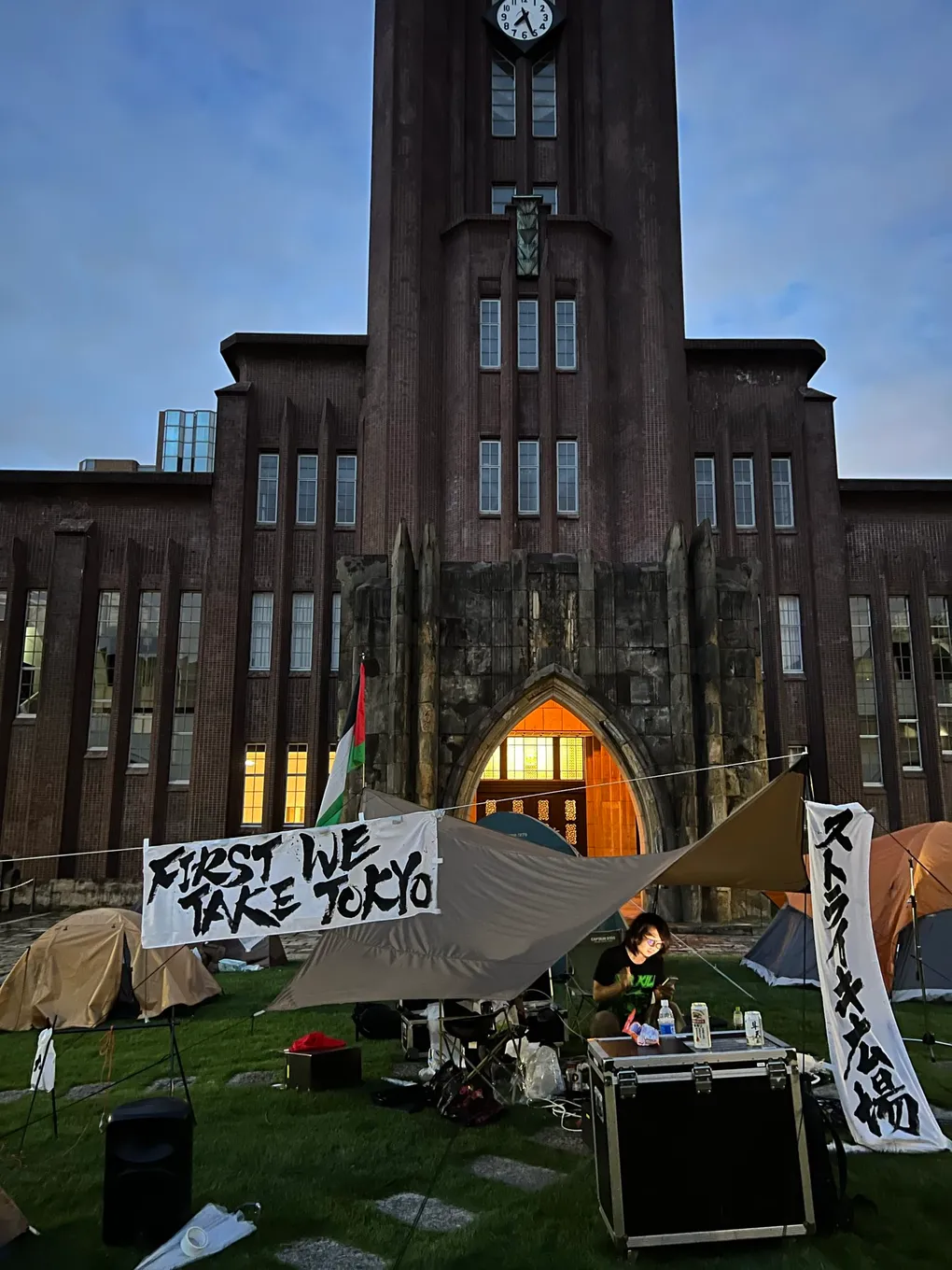
In 1968-1969, student militants occupied the iconic Yasuda Auditorium at Tokyo University, turning it into an emblem of the Red Years of postwar Japan. On the night of June 21st, 2024, protestors of a proposed tuition hike at Tokyo University took the auditorium again, albeit just for the night. This brief escalation came after a month of organized student opposition to a 20% increase in tuition and fees, about 110,000 JPY ($760 USD), the first such move in two decades that raised the sticker price of Japan’s top university to 642,960 JPY ($4500 USD) per year. It also followed a longer period of pro-Palestine protests on campus that blossomed into an encampment in the spring of 2024 in solidarity with the worldwide “student intifada.” I spoke to Tatsuki Kihira, a Japanese comrade active in organizing the 2024 tuition protests, about their approaches to composition and escalation, the movement’s vertical and horizontal connections, and the emergence of a Japanese alt-right.
Can you give a brief recap of the events that escalated to the occupation of Yasuda Auditorium? How and why did the tuition question become a rallying call in the spring of 2024?
The protest began right after the plan for a tuition hike was leaked in mid-May. A non-sectarian anarchist group called Dame-Life (“The Life of Good-for-Nothings”) led a demonstration during the annual school festival on May 19, 2024. Dame-Life is an alliance of university students throughout Japan who identify as “dame” (“impossible,” “no good,” “useless,” “hopeless”) and were inspired by the anarchist collective Dame-Ren (“The Alliance of Good-for-Nothings”) that began in the 1990s.1 Other participants included formal student self-governing associations (jichikai), student rights groups, liberal students that weren’t part of any group, and leftist and liberal professors, some of whom were students in the ‘80s.
Dame-Life’s tactics were more direct action-styled, and the student unions were more authoritarian, but neither gained broad student support within the movement. Members of Dame-Life made many attempts at demonstrating, including organizing a hunger strike, handing out shaved ice, lobbying in Parliament, and holding mock funerals and mock courts. They were so rigid about adopting a single-issue strategy that they set a ground rule about only protesting the tuition strike and nothing else—a practice that has become common in social movements lately, including in Japan. The student union, on the other hand, called for the unification of groups under union leadership. This was even less popular because they weren’t even negotiating with other student organizations.
On June 6, a general assembly was held that included a broad spectrum of groups and was attended by about 500 students in total. During that meeting, one student called for a student strike; this was widely applauded. This particular call for a student strike was important, for two reasons. First, it made us aware that our action together should be worker-based rather than consumer-based, a distinction that Bifo’s recent interview “Sabotage and Self-Organization” helped us articulate.2 Students could express grievances as disgruntled consumers, but they’d still be passive, individual subjects who would not be united by their grievances. Indeed, Tokyo University’s financial director called students “customers” in a meeting with student representatives, and the university ordered students to submit inquiries on their personal portals. Social movements are always at risk of becoming identified with a base of consumers in their solitary rooms. But students are also workers and producers; they are a collective subject that reproduces the university through the labor of research, political activity, socialization, and club activities, not just customers of the services provided by the university. The strike-call made us aware of our identity as workers and shifted our actions from placating with the bullshit justifications the university administration had made for the tuition hike to a more confrontational expression of our demands.
Secondly, the call for a strike was reminiscent of the student strike that initiated the 1968 uprising at Tokyo University, sparking a historical continuity and confidence in our collective power. This confidence led to a variety of escalatory tactics: some started a hunger strike, some started lobbying lawmakers, and most importantly, some started encampments in front of Yasuda Auditorium, where the university, in response to riots in the ‘60s, had planted grass to prevent students from gathering and protesting. This ironically made the encampment more comfortable. In mid-June, a Palestine solidarity encampment group active on another campus of Tokyo University joined our camp. This culminated in the lead-up to June 21, when the university president was expected to release an explanation for the proposed tuition hike.
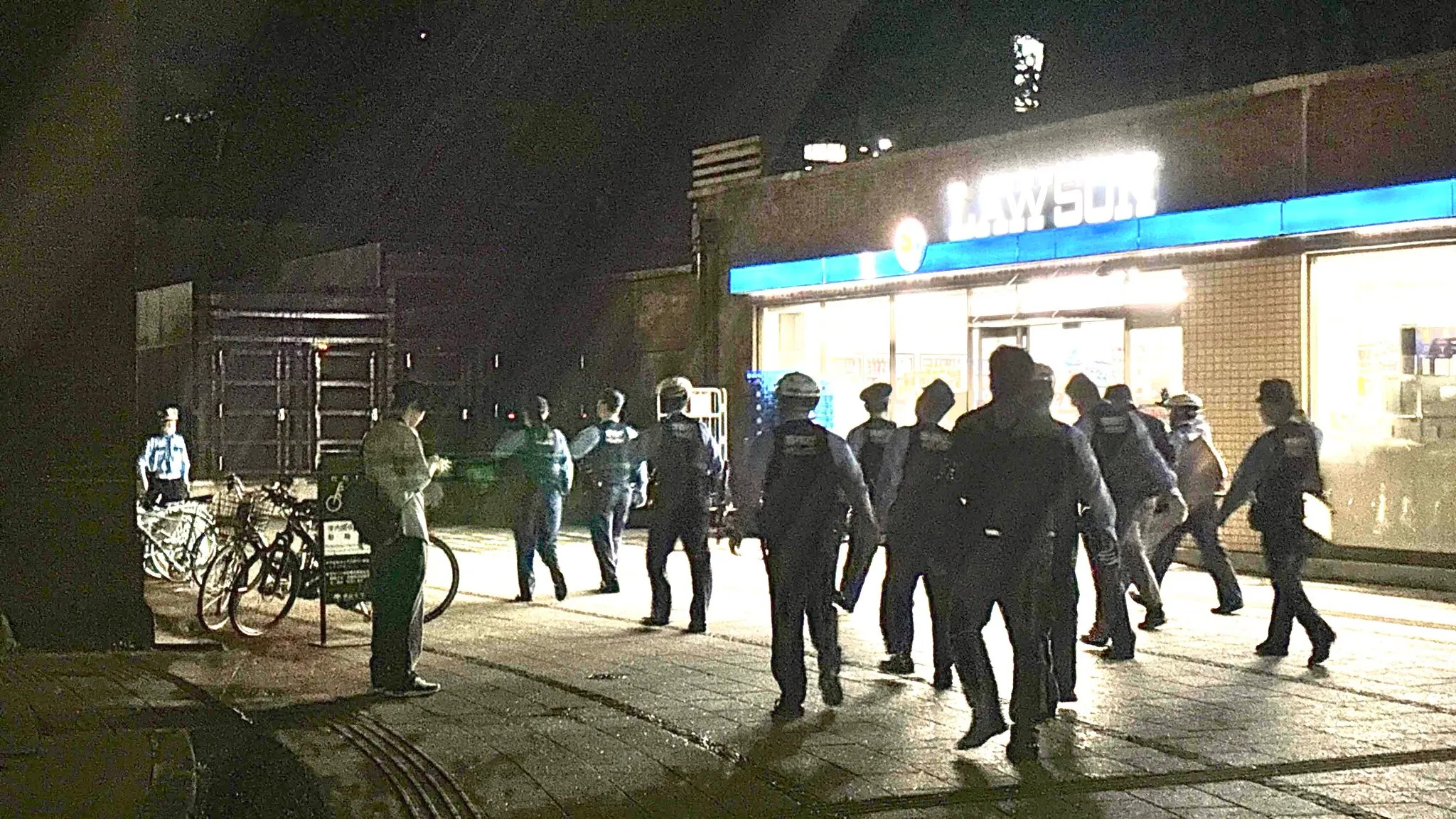
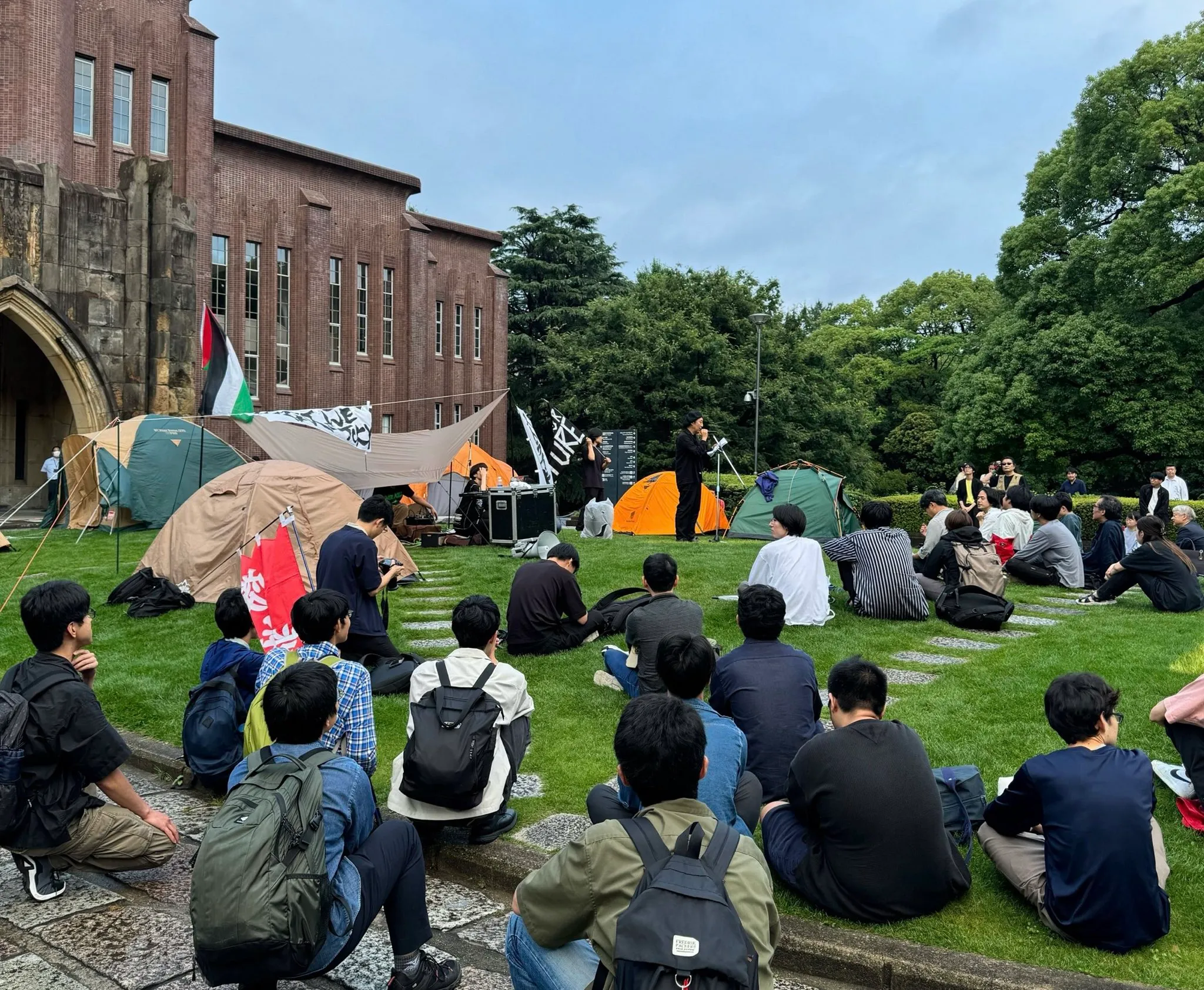
On June 21, we first held a meeting at the encampment. With a huge sound system, speeches were given in front of an audience of 500 angry students. The students then joined a public viewing where the president read his statement, which was conducted virtually because the university was afraid (correctly) that the students would get out of control. After the viewing, most students returned to the camp, even though it was already 9 p.m. The encampment had already functioned like a base for protesters. At the time of their return, when “Inoki Bom-Ba-Ye” (the theme music of Japan’s most famous professional wrestler Antonio Inoki) began to play, protesters got excited. It was a beautiful moment. To quell the riot, the university had to call in the police for the first time since 1969.
Can you describe your involvement in the movement, and how you worked with these different groups? What were some of the organizing strategies or interventions that you found effective, and why?
The idea of composition was deliberately introduced as an organizing strategy, and Hugh Farrell’s “The Strategy of Composition” was an inspiration for us.3 Since most students were wary of the student union’s call for “unification” under its leadership, and existing groups were indeed divergent in both political orientation and personal character, it was necessary to somehow realize the alliance of different factions while maintaining the autonomous intensity of each group. A specific composition was necessary so that we did not end up as an ordinary student movement in which we only express our moral refusal instead of becoming a political force. The groups involved seemed to agree on the need for composition and collectively made an effort towards this end. There were, of course, some conflicts: many liberal students left as the protest intensified, and we had to talk about setting “ground rules,” the concept of which I am personally skeptical. Composition was somewhat successful as a process of transformation: we changed each other in order to compose. For example, the single-issue strategy rule was dropped when the Palestine solidarity group joined the encampment. At the encampment, students held a reading group of Okayama Shigeru and Shiraishi Yoshiharu’s Shin Daigaku Genron (Theory Toward a New University), a book on the political philosophy of the university. Based on the reading, they proclaimed that the university must be anti-war through anti-capitalism, which justified the Palestine solidarity movement and the protest against the tuition hike together.
It was also important to create a territory on which we could compose. The encampment was where we gathered, ate lunch, and strategized together. By creating such a territory, as Kristin Ross points out, different groups could act based on local conditions instead of group logics that often caused conflicts. For example, we could focus on defending and maximizing the efficacy of the territory, fostering a sense of unity among the many groups. The point in creating a territory and cultivating unity was to escalate the movement. The encampment became the base for our collective force, although we did not sleep there overnight and could have done more. The historical weight of the place itself also made us more conscious of past student struggles. This led to many unaffiliated new students joining us.
Our success with composing had two effects that made the June 21 escalation possible. First, each group was compelled by its own agency in the riot, as the riot became their revolt, acting autonomously without losing a sense of our collective identity as student-workers. This active pull of agency would not have been possible if the organizing strategy was not compositional—if they felt that the event was compelled by a specific group. Second, the territorial character of the movement was the necessary condition for protestors to return to the camp after the action at the president’s public statement. It surprised us that the students returned to the encampment.
I was struck by the fact that an earlier generation of activists who participated in the anti-globalization movement said that the June 21 revolt left them with a feeling they had not shared in a long time. It is undeniable that we have various historical reasons to be pessimistic about political subjectivation in Japan, like the widespread nihilism about militancy after the United Red Army and the atomization of radicals after the Fukushima nuclear disaster in 2011. In the latter case, every aspect of life, including where to live and what to eat, became so intensely politicized. Conflict arose from such mundane things like meeting at a bar because of likely exposure to irradiated food. Some of the most radical activists left Tokyo and criticized those who remained as collaborators of the nuclear power system. The atomization was so severe that people with different views on radiation could no longer talk to each other.4
In a way, the June 21 revolt demonstrated a path towards optimism, even though it is still a very small hope. We need to acknowledge that the escalation was nowhere near sufficient. It resulted in a skirmish at one university. We failed to escalate the movement at large. We need to keep trying to break free from atomization.
How did protestors respond when the university, in the immediate aftermath of the protests, decided to push back its decision on a tuition hike? Was it considered a victory?
People around me agreed that we needed to make it a “victory.” This was primarily because we determined that no further escalation was possible and that we lacked the resources necessary to expand the movement. The summer break was around the corner; a decline in the movement was imminent. Also, we could not maintain the encampment due to the extreme heat in Tokyo, which has become oppressive in recent summers. Thus, affirming the victory and closing the movement was a kind of strategic retreat.
What has happened since the university announced the 20% tuition hike in September 2024? If there hasn’t been an organized direct-action response, why is that the case?
After June 21, the university began repressing the student protests through a series of investigations. The university summoned some students and asked what they did on June 21. But that was the extent of what they were capable of: the university did not understand internal organization of the movement because we intentionally made it opaque.
In the aftermath of June 21, the movement has also become more liberal and “pragmatic.” Some students tried to rebuild student unions and have encountered procedural difficulties; others have turned to lobbying. The lobbying has seen some success because most Japanese politicians seem in favor of tuition-free education. This is kind of funny because it is a political backlash against the backlash from the university administration. Public attention garnered by the protest at Tokyo University and the continuing efforts of liberal students have led to a student solidarity coalition at universities across Japan. This is good news for them, but the liberal turn means I’m no longer actively involved in the situation.
Did you see direct or indirect connections to the ‘60s-70s generation, either in terms of continuity in formal parties or organizations, or informal social and intellectual networks on and off campus?
We feel that the organizational continuity between the ‘60s and the current generation is continuing to disappear. Since the ‘80s, Japanese universities have gentrified campuses, demolishing dormitories and club houses that were the basis of prior student movements. At the same time, student self-governing associations, which played a major role in recruiting students to politics, lost their political influence. In short, leftists, whether sectarian or non-sectarian, failed to reproduce themselves. Most recently, we did not see the intervention of sectarian leftist or Marxist student groups that were commonplace in the ‘60s. This means that the number of professional activists on campus is really decreasing. But this has had a positive effect on the consciousness of history. We amateurs can intuitively feel the historical continuity where more traditional activists cannot. We can, without thinking too much, easily call for a strike and start a camp, because the ‘60s is just a textbook thing.
The rise of Dame-Life in the tuition strike most clearly demonstrates the organizational gap with the past. Unlike the traditional sectarian left, where political agents are, or are trained to be, ideologically aligned, Dame-Life includes different kinds of agents: anarchists, moralists, liberal democrats, anarcho-capitalists, and some who even call themselves “anarcho-fascists.” There are at least two reasons for this diversity: one general and one very coincidental. The general reason is, obviously, that the traditional left has lost much influence and can no longer reproduce itself. Sectarian organizations suffered significant damage, and non-sectarian anarchists have shown a lack of commitment to organization. The situation has become so dire that liberal popular movements are the only option for many. Aspiring students are organizationally lost and thus absorbed into movements like Dame-Life.
Specifically, an influencer and activist named Toyama Kōichi, who identifies as anarcho-fascist, is responsible for initiating students into politics. He first gained subcultural recognition in the 2000s when he ran in a Tokyo gubernatorial election and demonstrated an eccentric style of agitation that parodied traditional anarchists and made him into an internet meme. Every year, he holds a 10-day long free retreat-style study group where he teaches a distorted history of the Japanese left. Over the course of 10 years, about 400 students have participated, which is probably the largest anarchist involvement of students post-Fukushima. Large in number and diverse in character, including anarchist labor union activists, fascists, and mostly non-political students, people introduced to politics through Toyama’s retreats share one thing in common: they’ve all learned a history of the Japanese left distorted by Toyama. To them, it is his teaching that sustains a perverse connection to the ‘60s.
How did you and your comrades interpret the appeal of this self-proclaimed “anarcho-fascist” tendency to the youth? What’s anarchist or even leftist about Dame-Life? What’s actually fascist about them, in the context of more hegemonic fascism in Japan, past and present? Is there some kind of revolutionary agenda (if a reactionary one) that animates their social and historical negation?
It is an unfortunate fact that Dame-Life, a group that is essentially contrarian, has become more mainstream in activist circles. It is also a problem that some self-described fascists are becoming parasitic in certain radical scenes in Tokyo, possibly because of Toyama’s influence. Toyama began his political career as a peripheral member of the anarchist movement, including Dame-Ren, and gained popularity online for his performances parodying the left. His political character—like his self-proclamation as a fascist, his problematic behavior, his sexism, which is not popular even within Dame-Life—should be understood as a negative reaction to the traditional left in Japan. To them, identifying with some kind of fascist accelerationist futurism from the early 20th century is a way to be a “real anarchist,” contrary to existing anarchists who are “weak” or the more traditionalist nationalist far-right. Of course, we cannot cooperate politically with people who openly identify as fascists. I’ve personally never talked with a self-described fascist Dame-Life, as that would be useless. They should be pushed out from movements, because public engagement and criticism only increase their subcultural popularity, which they gain by being different from other leftists, not other right-wingers.
But Dame-Life also includes many young activists who are not fascists, despite a possible affinity for fascism or accelerationism instilled by Toyama. My experience shows that it is not at all impossible for revolutionaries to cooperate politically with them. Most of them aren’t actually fascists; 90% of Dame-life are just regular, liberal-minded youth. They’re often early-career radicals, upper-middle class university students, who were consistently among the most militant and cooperative figures during the tuition protests. It seems to me that Dame-Life’s tactics often stem from a desire to be different, which makes them the most active element in the movement but can be an obstacle for organization. Being radical is an easy and righteous way to be different but also pigeonholes them into ridiculing and criticizing others that aren’t active enough for them. They also seem to be in constant danger of internal conflicts because of their diversity, with the leftist members feeling disgust toward the more fascist members. Dame-Life have a compositional problem within themselves that their way of organizing, which largely depends on the internet, cannot solve.
We can’t change the fact that some students got politicized by Toyama, but I don’t think there is much positive substance to the so-called anarcho-fascism that we should take seriously. It’s mostly a story of organizational failure on the left. Dame-Life are not the real enemy, especially when compared to actual fascist populist movements and far-right parties like Sanseitō, though they will pose a compositional problem for organizers for a while.
You are saying that even the reactionary tendency in Dame-Life is still more of a reaction to the left, not a subcultural form of far-right nationalist and populist organization?
Yes. They shouldn’t be conflated with openly racist and xenophobic “Japanese first” right-wing parties, to whom Toyama’s crew is still fringe leftist. The problems I outlined are familiar features of youth radicalism; they want to be radical but often lack a revolutionary outlook. As the appeal of old leftist sectarianism declined, Toyama’s presence grew, because unlike other anarchists, he strategically organized left and liberal-minded students. This is unfortunate but not a hopeless situation. I’m more interested in the possibility of their growth and in providing them with a more revolutionary perspective, given that Toyama’s distorted history class is often the only basis for their politics. In this sense, instead of blaming Dame-life for their moral and political failings and ignorance, we should think about the revolutionary possibility that they become friends of ours in the future.
In Japan, the left shares a historical common sense that there is no political use to morally blame others, largely due to memories of repeated factional splits and internecine killings motivated by moral purification. The case of the United Red Army was the most tragic expression of this kind of failure. Not only do we fail to gain political force, but we also lose it once we embark on a journey of moral purification. We are aware of this fact because our nihilistic current is the consequence of that. I am not suggesting that we should abandon our contempt for the fascist tendency, nor do I endorse the laissez-faire liberalism willing to recognize any idea or identity. My point is that it’s pointless to beat up on people we have contempt for. Moral criticism creates a self-fulfilling prophecy here because it only proves Toyama’s teaching that leftists are the enemy. Our focus should be on how to organize and reproduce revolutionaries, because the real enemy is capitalist power.
Returning to the university as battleground, at elite U.S. universities that capitulated to attacks by the Trump administration, cost of attendance can reach $90,000-100,000 USD per year. The criminalization of pro-Palestine speech and weaponization of vulnerabilities of international students and faculty have enabled the right to assert domination over these institutions crucial to U.S. hegemony. Tokyo University, along with other Asian and European universities, have been courting international students and scholars exiting the U.S., though it remains to be seen how activists can intervene in conflicts that will surely emerge from these attempts at realignment. I’m curious how this might impact the future of campus politics in Japan as a site that bridges international and local struggles?
As I mentioned, it was crucial that Palestine solidarity activists joined the camp. Having the Palestinian flag in the symbolic space of the student struggle created an indescribable atmosphere of unease that strengthened our power. For example, a typical Zionist tweet said it was wrong for the university to call the police to repress “peaceful students,” but that there might be “extremists” like the Japanese Red Army among the students because they were holding the Palestinian flag. So the flag helped the movement not be consumed by the media as simply an expression of discontent by “poor” students. It also rallied many international students, one of whom gave a very passionate speech in perfect Japanese and agitated the protesters on June 21. It has been a feature and strength of the Palestine solidarity movement that it attracts people of different origins. For a largely homogeneous country like Japan, it is important for movements to gather many international political subjects.
On the other hand, the Palestine flag attracted mostly European students, and the tuition protest did not effectively mobilize international students as a whole even though the tuition hike affects them directly. For example, Musashino Art University in Tokyo raised tuition only for international students, an extra 20% or 363,000 yen (USD $2,500), but there seems to be no active organization of international students about it. This is likely because tuition is still affordable for middle and upper middle-class students from China, who make up a large part of international students in Japan. We need to consider the difference between internationalist movements like Palestine solidarity and more local movements like the tuition protest, and how to organize with Chinese students. The latter is really a pressing question that may be more important than organizing Dame-Life.
The involvement of international activists in Japan should pose a significant challenge not only for student movements but for revolutionary movements in general. Spaces in Tokyo, such as TKA4 in Koenji and Irregular Rhythm Asylum in Shinjuku, have been doing a lot of work to connect international activists to Japanese movements. We must create additional systems that allow activists who come to Japan for different reasons, including political asylum amid Trump’s attacks on universities, to stay and live committed political lives. We need more foreign organizers who can cultivate and mobilize international activists. Otherwise, the scene might be filled with people aimlessly wandering around, simply seeking a sense of community. We must transform Tokyo into a political metropolis rather than a tourist attraction.
Tatsuki Kihira is a graduate student and activist based in Tokyo
May Wren is a writer living between the U.S. and China
Footnotes
-
For the political context of Dame-Ren, see Sabu Kohso, “Life of Militancy: Japan’s Long ’68.” Ill Will, January 12, 2024, https://illwill.com/life-of-militancy ↩
-
See Franco ‘Bifo’ Berardi, “Sabotage and Self-Organization,” Ill Will, May 7, 2024, https://illwill.com/sabotage-and-self-organization ↩
-
Hugh Farrell, “The Strategy of Composition,” Ill Will, January 15, 2023, https://illwill.com/composition ↩
-
Another factor contributing to the division among radicals after Fukushima was the conflict regarding attitudes toward right-wing participants in the anti-nuclear movement. For example, there was disagreement about whether organizers should prevent them from raising national flags. Additionally, numerous activists were imprisoned around that time, leading to a contraction in the radical movement. ↩